Stage Costume as a Clue to Character
Stage costume can reveal character through silhouette, condition and change. Learn to shape clear visual clues that audiences can read across the theatre.
A stage costume can announce a character before the actor speaks: a stiff collar, a work-worn apron or a coat worn inside out gives the audience something concrete to read. The most useful design question is not simply “Is this beautiful?” but “What does this garment let the audience understand?”
What can clothing tell us about a character?
Costume clues begin with recognisable details. A uniform suggests an institution and its rules; a formal jacket can imply a public role; a patched hem may hint at limited means or long use. These are invitations to interpret, not fixed codes: a uniform can be borrowed, a fine coat can be theatrical pretence, and a worn garment may be cherished rather than neglected.
Silhouette is often the quickest signal. A broad shoulder line can make a figure appear imposing, while a narrow, carefully closed shape may suggest reserve. Fabric and finish add texture: crisp cotton, soft wool, dull canvas and reflective satin catch stage light differently.
Small details become useful when chosen with purpose. Gloves may mark a barrier between a character and the world; a loose tie can suggest that composure has begun to slip; a repaired seam may show resourcefulness. One clear clue often reads more strongly than a cluster of unrelated symbols.
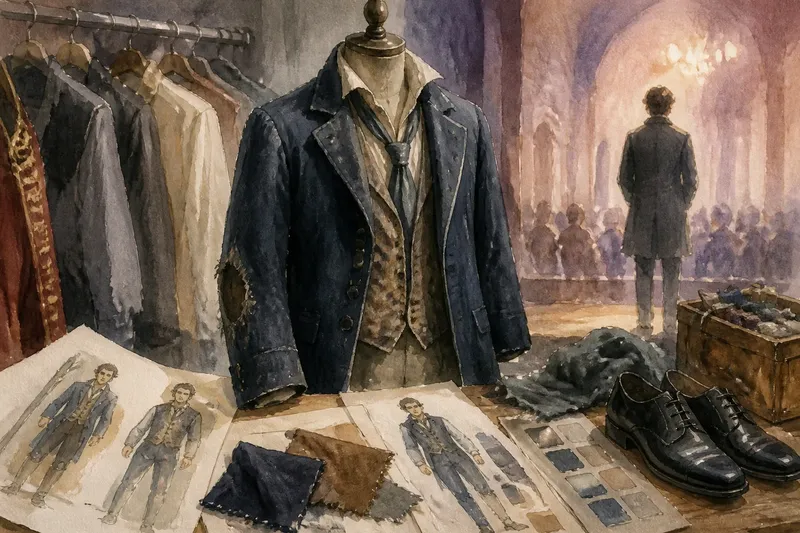
Say a fictional production places a young clerk at a formal reception. The starting point is a borrowed jacket with sleeves slightly long and carefully polished shoes; the designer keeps both details visible as the clerk enters. The expected result is that the audience can read effort and social unease before the character tries to fit in through dialogue.
How can stage costume signal status?
Status is not just a matter of expensive fabric. It can appear in condition, fit, access to choice and the way a garment is worn. A character with authority may have a coat that fits precisely, while someone with less control over their circumstances wears clothes chosen by an employer, family or institution.
Contrast helps make relationships visible. Put two characters in similar dark coats, then give one immaculate cuffs and a distinctive lining, and the other a mended elbow and a collar that has lost its shape. The difference can suggest unequal resources without turning either person into a shorthand stereotype.
Costume can also show status being performed. A character may dress above their means to claim respect, or reject a formal dress code to challenge the room. The audience reads both the clothes and the gap between the clothes and the wearer’s behaviour.
For a group, consider who gets to choose, alter or remove each garment. That decision can reveal hierarchy as clearly as colour or decoration.
How can a costume show transformation?
A transformation does not need a full change of outfit. A loosened collar, removed jacket, rolled sleeves or a hat set aside can mark a shift in confidence, intimacy or intent. Since the audience has seen the original arrangement, a modest alteration can suggest change.
Repeated details create a visual thread. A character might begin with a bright scarf worn tightly at the throat, then later wear it loosely or give it away. The object remains recognisable, but its changed use suggests a changed relationship to the person or idea it represents.
Make the change legible under the production’s conditions. A tiny adjustment may disappear in a large auditorium, while an exaggerated one can overwhelm a quiet scene. Consider the audience’s distance, the pace of the moment and whether the actor can make the adjustment naturally within the action.
For a design note, describe the before and after in visible terms: buttoned or open, polished or scuffed, carried or abandoned. Avoid assigning a broad historical story to the change unless the production has a clear, specific basis for it.
What should you ask when designing stage costume?
Should a costume be historically accurate?
Historical detail can help establish a period, but accuracy should serve the production’s dramatic needs and visual language. Check the script, the director’s approach and relevant costume references, then decide which features matter onstage and which can be simplified.
How can costume communicate without becoming a stereotype?
Give characters more than one visual cue, and make sure their clothes fit their circumstances rather than a broad assumption about class, occupation or identity. A garment can signal a role while its wear, alteration or combination with other pieces gives the character individuality.
What makes a costume clue visible from the audience?
Prioritise shape, contrast and placement over minute surface detail. A distinctive collar or strong change in silhouette is easier to read at a distance than a subtle stitch, though close-up performance may allow finer choices.
How should a costume support movement?
Consider what the actor must do: sit, reach, turn, run or handle another garment during the scene. If a costume restricts an essential gesture, revise the cut, fastening or layers so the action remains clear and comfortable.
How do you check a stage costume clue in rehearsal?
Begin with a short character note rather than a shopping list. Record the role the character occupies, the impression they want to make and one detail that complicates that impression. Then check each design choice against what the audience should notice.
- Observe the first impression. If the intended role or quality is visible when the actor enters, keep the dominant signal; if it is not, simplify the competing details or strengthen the silhouette.
- Check the view from the back of the room. If the main shape or contrast reads at that distance, retain it; if it disappears, move the clue to a larger or clearer area of the garment.
- Watch the actor’s movement. If the actor can sit, reach and turn without fighting the clothing, keep the cut; if a needed gesture is restricted, alter the seam, fastening or layer.
- Observe how a prop or pocket is used. If the garment supports the action without snagging or hiding the object, keep the arrangement; if not, reposition the pocket or change the fastening.
- Check condition details for consistency. If a repair, stain or polished surface matches the character’s circumstances, preserve it; if it contradicts the intended story, revise the garment’s finish.
- Watch a costume change at scene pace and in stage light. If the adjustment is visible without interrupting the action, retain it; if it is missed or distracts from the scene, make it clearer or remove it.
Imagine a fictional rehearsal in which a character is meant to appear self-assured, but the first costume has a dark jacket, bright patterned tie, shiny shoes and a conspicuous pocket chain. The starting observation is that the actor’s entrance reads as a collection of details rather than a single impression. The designer removes the pocket chain, keeps the tie as the focal point and checks the entrance from the back of the room; if the tie now directs attention without obscuring the actor’s movement, it stays, while any distraction from the shoes can be addressed by changing their finish. The expected result is a clearer visual emphasis, with the actor’s behaviour still free to complicate it.
Why can a restrained costume clue read more clearly?
Costume shares the audience’s attention with dialogue, movement, scenery and light. If every garment carries a loud symbolic detail, the eye has no clear path through the visual information. A focused choice gives the audience somewhere to look and leaves room for the actor’s behaviour to deepen its meaning.
Restraint does not mean plainness. It means deciding what the audience should notice first, then ensuring the rest of the design supports that reading. A courtly coat may glitter, while its cut, fit and condition suggest whether its wearer commands the room, borrows its authority or is beginning to outgrow it.
A clear stage costume clue gives the actor something concrete to complicate with a glance, gesture or altered way of wearing the garment. In rehearsal, check that the audience can see the change as well as the clothing itself; that distinction keeps costume expressive without asking it to explain the whole character alone.