A Clear Sightline Plan for a Small Living-Room Reading
A clear sightline plan for a small living-room reading helps guests follow every speaker, with practical seat placements and a simple playing area.
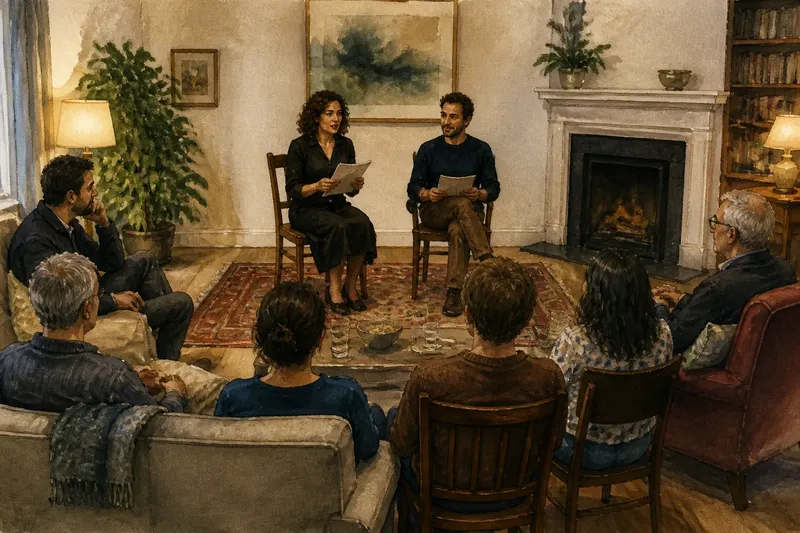
A clear sightline plan for a small living-room reading begins with one plain question: can each guest see the speaker without leaning around someone else? In a lounge with a sofa, armchairs and a coffee table, a few deliberate seat choices can make the action easy to follow without turning a friendly gathering into a formal production.
The aim is not to give every person a perfect view from every angle. It is to give the performers a clear, defined place to speak, then arrange the audience so faces and gestures remain visible. Start with these decisions before guests arrive, and adjust the room to suit the script and the people in it.
1. Where should the playing area sit?
Choose a patch of floor that most seats can face naturally. A short wall or the open side of the room often works better than a corner: performers can stand against a calm background, while the audience can gather in a shallow curve. Keep the playing area compact enough that performers do not have to project across the whole room, but broad enough for two readers to stand side by side.
Mark the area in your mind using fixed features, such as the edge of a rug or the line between floorboards. A rug can suggest the boundary without tape or scenery. Avoid placing a bookcase, bright window or television directly behind a reader if its visual busyness will compete with faces.
Leave a clear route into and out of the playing area. Readers should be able to take their places without threading between knees or stepping over bags.
2. How should you place the seats?
Begin with the seats that are hardest to move: usually a sofa, then a large armchair. Place them facing the playing area, with their front edges forming a gentle arc rather than a straight row. Add lighter chairs or dining chairs to fill gaps, keeping each seat angled towards the readers rather than directly at the back of the person in front.
In a small room, avoid building deep rows. A second row may be necessary, but stagger its chairs so each person looks through a gap between heads in the row ahead. If the room has only one sofa and a pair of chairs, bring the chairs slightly forward and turn them inwards; a modest angle can expose the readers’ faces to people at either end of the sofa.
- Keep the audience’s front edge clear of the playing area.
- Angle outer seats towards the centre of the action.
- Stagger seats in any second row.
- Move side tables that block a reader’s face from a low chair.
Try the arrangement from the least favourable seat, not just the one nearest the centre. If that person can see the readers without craning, the layout is probably doing its job.
3. What should you do about the coffee table?
A coffee table can become an accidental barrier, especially for children or anyone sitting low. If it sits between the front row and the readers, move it to the side or push it back towards the sofa. Keep drinks and scripts off the central sightline; a cluster of bottles can obscure a seated reader’s hands and lower face.
If the table cannot be moved, treat it as part of the room’s boundary and place the audience behind it. Do not ask readers to stand directly behind a tall arrangement of refreshments. A clear surface also gives people somewhere to rest scripts without turning the performance area into a cluttered desk.
4. How can you check every seat?
Do a quick view check before the reading. Sit in each place, look towards the playing area, and notice whether a lamp, plant, doorframe or another person’s shoulder cuts across the view. Check at seated eye level: a layout that looks open while standing can feel blocked once everyone sits down.
Ask one reader to stand in the playing area and speak a few lines while you move between seats. Watch whether their face remains visible when they turn slightly to address another reader. If a seat only works when everyone holds still, shift it or leave it out of the audience arrangement.
Say you have a sofa facing the fireplace and two chairs beside it, with one chair hidden behind a floor lamp. Move the lamp to the room’s edge, turn the chairs towards the space between the fireplace and sofa, then sit in the back corner; the expected result is a clearer view of both readers without changing the room’s main furniture.
5. What changes when readers sit or move?
Choose a simple convention for where readers will be. If they remain seated, place their chairs in the playing area with a little space between them and angle them towards the audience. If they stand, keep them within the same defined patch rather than letting them drift towards a side wall or a doorway, where some guests may see only a profile.
For a script with several voices, make transitions legible. Readers can turn towards the next speaker, or shift their gaze to a consistent position, without crossing in front of one another. The audience should be able to connect a voice to a face; complicated blocking is rarely needed in an intimate reading.
Keep any movement small and purposeful. A reader who steps forward for a key exchange can help focus attention, but a constant shuffle makes the playing area harder to read.
6. What should you check before guests arrive?
- Speaking faces: Can the audience see the readers’ faces from the outer seats?
- Head overlap: Does a person in the second row look through a gap rather than directly at someone’s head?
- Low views: Can a shorter guest or someone in a low chair see above the coffee table?
- Background: Is there a bright window or busy shelf directly behind the readers?
- Access: Is there a clear route to seats and to the playing area?
- Reading material: Can readers hold scripts comfortably without hiding their faces?
Make one adjustment at a time, then check the affected seats again. A chair moved only a little can open a view; adding more furniture or decorative markers may solve nothing if the real obstruction is a lamp or table.
Which sightline questions come up most often?
Should the audience sit in a straight line?
A shallow curve usually gives side seats a better angle towards the readers. A straight line can work if the room is narrow and everyone faces the playing area directly, but avoid placing the end seats too far around the side.
Is a raised seat necessary?
Not usually for a small living-room reading. First try removing an obstruction or staggering chairs; if a guest needs a different seat, offer a stable chair that suits their comfort rather than improvising a platform.
Where should the readers sit?
Place them where the audience can see their faces without looking past a lamp or large object. If two readers share the space, leave enough room between their chairs for each to turn towards the other and still address the room.
How much space should be left between audience and readers?
Leave enough room for readers to enter and for the front row to sit comfortably, without stretching the room so far that expressions become hard to read. The right gap depends on the furniture and the movement in the script, so judge it from the seats rather than by a fixed rule.
How do you keep the arrangement welcoming?
A good sightline plan should feel like an invitation, not a set of rules. Let guests choose comfortable seats, and be ready to shift a chair if someone cannot see or prefers a different position. Keep the route to the door open and leave room for anyone who needs to move without interrupting a reader.
For a small living-room reading, the most useful final check is simple: sit where the least central guest will sit, look towards the playing area, and ask whether you can follow a quiet exchange. If the answer is yes, preserve that view when people arrive by keeping bags, lamps and refreshments out of the shared line of sight.